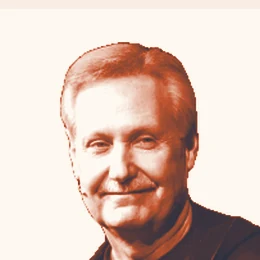
The slide said Market Update. He never went back to the market. Seventy seven slides on identity, motivation and fear, and the thing the room carried out was not a slide. It was a story he told about himself, a few days old, and it is where this attraction begins.
Pre-show · Six Seats Down
Sixty nine years old, and afraid to walk six seats.
The session was called FearFit. The thing the room carried out was a story Gary Keller told about himself, a few days old when he told it. It goes first.
A few days before Mega Camp he was at the NBA Hall of Fame induction, in a room full of his basketball heroes. Six seats down sat Calvin Murphy, almost eighty, one of the heroes from his childhood. Keller wanted to go and say hello. He was afraid they would not let him, or that Murphy would be rude, or that he would embarrass himself. He sat with it for nearly four hours.
When it broke up he went after him, caught him on the stairs, and said hello. Murphy heard him out, then told Keller's wife he loved this guy.
Hold on to the four hours. The next twelve stops are him taking them apart, and the last stop comes back to this room for the question he put to himself. Stop one is straight ahead.
"You know, you've been waiting for me to come up and say hello."
Gary Keller · to Calvin Murphy, on the stairs
Stop 01 · The Zone
What zone do you choose to live in?
He opened with three stone cutters. One said he was breaking rocks. One said he was earning a paycheck. One said he was building a cathedral. Same hammer, same hours. The only difference was what each one believed about himself.
Then he put a line on the screen. At the far left, everything you do is a hundred percent comfortable, a hundred percent natural, easy. He calls that the maintenance zone. At the far right, everything is a hundred percent uncomfortable, a hundred percent unnatural, hard. That is the achievement zone.
He has no patience for the usual definition of hard work. "Long hours are not hard. Anybody can do that. Just show up for an extra hour." Hard is doing what comes unnaturally until it starts to feel natural. That is the only definition he will accept.
All natural, all easyAll unnatural, all hard
The claim underneath the chart is the uncomfortable one. Stay in what comes naturally and life gets harder over time. Spend time in what comes unnaturally and life gets easier. Most people never make that trade on purpose, which is how they end up making their own lives harder without noticing.
"Life can get easier or harder over time. It's your choice."
Gary Keller · from the slide
Stop 02 · The Override
Did you change, or did you just build an override?
Here is his test, and it is a cruel one. You train every morning for four years. You never miss. Then you travel for four weeks, and it is gone.
His reading: the underlying behaviour never actually changed. An airport and a hotel room could not have undone it if it had. What was doing the heavy lifting was the alarm clock, the six in the morning slot, the trainer, the friend who was waiting. Nothing wrong with any of that. It just was not you.
For an override to become real change, he says two things have to happen. You have to genuinely start to like the thing itself, not the discipline of doing it. And at some point you stop deciding whether to train and start being a person who trains. That one is durable, because it travels. It is in you, not in your gym routine.
"There's no truer version of you buried underneath waiting to get out."
Gary Keller
Which leads to the line that got the biggest silence in the room. What feels natural to you right now is not your true self. It is just whatever got installed first and has run the longest. Your upbringing, your environment, whatever got rewarded. It feels like bedrock because it is old. Run something new for long enough and it is every bit as natural as the old thing.
Stop 03 · The Horsemen
Five layers, and only one of them shows.
He calls them the five horsemen of who you are. Four of them live entirely inside your head. The fifth is the only one anybody else can see, which is why it is the only one that counts as proof.
The way he describes the fifth: the audio and the video have to match. The way you talk has to match the way you walk. Reps are the video.
"Without reps, self-image confirms a claim. With reps, it confirms evidence."
Gary Keller
Stop 04 · The Fork
Ego is not the enemy. It is fuel pointed somewhere.
He took a swing at a book in the room. "I know our friend wrote a book. Ryan Holiday, Ego is the Enemy. Ego is not the enemy." His argument is that ego is just energy, and energy has to be pointed at something.
It gets pointed at one of two things. It can serve your self-image, which is the picture you hold of yourself and quietly hope other people hold too. Or it can serve your self-identity, which is your character, the person you are committed to becoming whether or not anybody is watching.
If you have not decided on an identity, you do not get to choose. Ego goes straight at the image by default.
This, he says, is why so many high achievers are miserable. The ego is enormous and it is bolted to an image. Every criticism becomes a threat. Every failure becomes an assault on who they think they are.
Bolt the same ego to an identity instead and failure turns into information. I did not fail because I am a failure. I failed on my way to becoming. Same ego, same energy, completely different life.
Stop 05 · The Cycle
Worth starts it. Reps make it true.
The five layers are not a list. He runs them as a loop, and the loop only turns when a rep goes through it.
Every rep gives your self-image something real to confirm. A confirmed image strengthens your identity. A stronger identity makes the next rep easier. Round and round, and after enough rounds it stops being something you are doing and becomes who you are.
He is specific about where it breaks. Identity decided, ego driving, no reps happening. Now self-image has nothing to confirm except the claim that you are this. That, he says, is where imposter syndrome comes from. Not from being a fraud. From having said something about yourself that you have not yet built the evidence for.
"Worth gets you to start. Identity sets the direction. Image reflects it back. Ego drives it. Reps make it true."
Gary Keller · the mantra
Stop 06 · The Four Boxes
Nobody is unmotivated.
"I have never understood I am not motivated. Of course they are motivated. They are motivated to eat. They are motivated to sleep. They are motivated to check their phone."
You are always motivated toward something. When someone says they are not motivated, what they mean is they are not motivated to do that. So the useful question is never whether you are motivated. It is what you are motivated toward, and then what you are willing to do about it.
Two axes, four boxes. Only one of them goes anywhere.
Top row motivatedRight column willing
Underneath the boxes sits the harder claim. Maintenance is an illusion. Nothing waits. Your health does not wait, your relationships do not wait, your career does not wait. If you are not moving forward you are going backwards, and at sixty nine he says you find out that you have to work harder than you ever worked just to stand still.
"We're either making the effort to grow or we're rolling backwards. That's science. That's not my opinion."
Gary Keller
He also wants a word retired. Replace motivation with reason. Reason is what causes motivation: something needs to change, a reason gives it fuel, and the fuel makes the energy to act. An okay reason is okay motivation. A great reason is great motivation. Add willingness, which is choosing to do the thing, and resolve, which is the commitment to stay willing, and you have the whole of what people call motivation.
Stop 07 · The Arcade
Three things everybody believes about motivation.
He called the first one worth the price of admission. All three are the reasons people sit and wait for a feeling that was never coming.
Try it · three throws
Hit a bottle. See what is behind it.
0 of 3 knocked down
Hit a bottle above. What is actually true shows up right here.
What is actually true
The one he wants you to leave with is the third. The things that really matter are usually the hardest to get. Difficulty is not a sign you are on the wrong path. It is usually proof you are on the right one.
Stop 08 · The Eight
One of the biggest lies we tell ourselves is that I am fearless.
Fear, in his definition, is your mind predicting that something bad could happen. Everybody has it. He listed the business version out loud and the room went quiet: I will not make it. I will lose everything I built. I am afraid I will regret my choices. I am afraid my people will leave me. I am afraid my competitors will beat me.
Then the slide he spent the longest on. Eight things people believe about fear, and what he says is true instead.
"The difference between average and extraordinary isn't the absence of fear. It's what you do with it."
Gary Keller
He also thinks fear is learned rather than born. Your choices were made for you before you could make them, and a lot of what you now feel is your own interpretation of messages you picked up growing up. He is careful not to turn that into blame. Conditions change as you grow up, which is exactly what lets you go back and reinterpret them. "Fear is born of the struggle" between holding on to what got imprinted and building something new.
Stop 09 · The Odds
Two kinds of fear, and only one deserves your attention.
A rational fear is based on fact. The house is on fire. You should be afraid of that, and you should get out. Respect it, listen to it. An irrational fear is an opinion. It is built on assumptions and imagined outcomes with no evidence that any of it is going to happen.
Then he gave the room some numbers. Put in how many things you are carrying around this week and watch what his figures do to them.
9never happen at all
1happen in some form
0.01happen at a level you would call bad
His figures, not a study, and worth saying plainly. He said ninety percent of what you are afraid of never happens, and that of the ten percent that does, only about one percent of that lands at a level you would actually call bad. He then rounded it aloud to ninety nine to one. Those are two different claims and the exact arithmetic is his. The shape of it is the part that matters.
"Living in the danger zone would be the worst possible life, because you'd be paralysed by everything."
Gary Keller
Stop 10 · The Trap
Relief is the trap.
Avoidance is not the answer, and the reason it fools people is that it feels exactly like the answer. Dodge the thing that matters and you get instant relief. Nothing bad happened. Except nothing bad happened because nothing happened.
And then the relief does something to you. It teaches your brain that the thing really was dangerous, because look how good you feel about not having done it. Press the buttons below a few times and watch which way it goes.
How big the fear is now50
He tested it on himself in public. If he had flown to the Hall of Fame and not walked over to the man he had come to see, he would have got back to the hotel and thought: I flew all this way, I was ten feet away, and I did not have the courage to say hello and thank you. Running that scenario is what got him out of the seat.
"Relief now is just bigger fear later. You are not lazy. Your alarm system is tricking you."
Gary Keller
Stop 11 · The Diagnosis
Why are you not doing the thing?
This was the flowchart, and it is the most useful slide in the deck. There are only three reasons anybody does not act, and he walks you down them in order until one of them is you.
Here is where you are
If you are motivated, and you know what to do, and you know how to do it, and you are still not doing it, he will not let you call it laziness. "Folks, I am telling you, it is fear. If you can accept that and not fight it, your life will change today."
Three ways out, and only three. Two of them work on your thinking. One works on your actions.
Train the thought.
Your mind is being programmed either way. Every experience, every disappointment, every conversation is teaching it what to expect. The only question is whether you are doing it on purpose. Affirmations are just deliberate instructions, repeated until they become the way you see yourself.
He was a sceptic. In his twenties they sounded like feel good statements with nothing behind them. He changed his mind when he got to the science. Here are eleven of his own, the ones he prints on t-shirts and coffee mugs at home.
Win the morning, win the day.
Life is lived from the inside out.
Subtraction leads to addition.
Action creates clarity.
What you feed yourself defines you.
Consistency beats everything.
Accountability creates freedom.
Reality never goes away.
The path is in the map.
No one succeeds alone.
Your best life is lived by giving your best effort to what matters most.
He is specific about the timing. The first five hours after you get up, whenever you get up. Win the morning, win the day.
Train the action.
The second lever is somebody else's head. A coach, a mentor, or a therapist, somewhere safe, talking it through. The third is the one he keeps coming back to, and it is the only one that touches what you actually do.
Exposure. Facing the thing on purpose, in small steps, in a safe place, over and over. What you learn is that there was no reason to be afraid, nothing bad happened, and you got good at it. And here is the part most people get wrong: exposure does not delete the old fear. It builds new learning that competes with it. That is why fear can still turn up under stress, and why people who have practised responding differently can act anyway.
"You don't think your way out of fear. You practise your way through it."
Gary Keller
What that looks like on a Monday.
In his industry it has a name. The daily huddle. Thirty to forty minutes, at least four days a week. Somebody models a real conversation. You pair off and role play it, by phone or in person. Then you come back and talk about what happened. Safe, non judgmental, and repeated.
He built his own career on it. Six thirty in the morning, a conference room, and his partner Tim Leggett. "Tim, why don't you buy it?" Nope. "Tim, why don't you let me list your home?" That is how his mornings started. He got good at talking to people as a consultant, and then went out and did it for real. He sold five houses in his first thirty days in a city he had never been in, and he says he was scared to death the whole time.
His challenge to the room was pointed. A real estate professional has two things to learn. The industry itself, which is value and what creates it and takes it away in your market, the transaction, financing, title. And being a good consultant, so that when you use that information you can guide somebody to their best decision. Then he asked how many hours anybody had put into practising the second one on safe people. The silence was the answer.
Stop 12 · The Overlook
Would he be afraid to do it again?
Back to the pre-show. Once Keller had told the room about Calvin Murphy and the four hours in his seat, he asked himself the obvious question out loud. Knowing how it turned out, if he went there again, would he still be afraid?
"The answer is yes. The answer is yes."
That is the whole point of the talk. The fear did not go anywhere. He is sixty nine, he has built one of the largest real estate companies in the world, and he still had to sit with it for four hours. What he has is not the absence of the thing. It is the training to move while it is still there.
"The goal isn't to be fearless. The goal is to become FearFit. Fear isn't the enemy. Being unfit for fear is."
Gary Keller · the last slide
You were not born physically fit. You trained for it. You were not born mentally fit. You trained for it. He does not see why fear would work any differently.
And the fear that never leaves, he says, is the small one everybody has every morning. Will this be a great day? Will this be a day where I actually move forward in my life?
Passport complete
All twelve stops stamped.
Come back for the next attraction.
I am writing up the rest of Mega Camp. Each session becomes its own attraction. Leave your email and I will send you a ticket when the next one opens.
Your address goes nowhere except my list.
These are my notes from a live session at KW Mega Camp 2026 in San Antonio, Texas, checked against the recording and photographs of the slides. Figures, frameworks and quotes are as Gary Keller gave them, including the numbers on fear at stop nine, which are his and not a cited study. None of this is medical, psychological, investment, tax, or legal advice. If fear or anxiety is affecting your daily life, talk to a professional who can actually see you.